
What's inside
As an Amazon Associate I earn from qualifying purchases. This post may contain affiliate links at no extra cost to you.
The best trellis nets for grow tents do one job with outsized consequences: they turn a crowd of competing tops into a single flat canopy, every cola at the same distance from the light, every branch supported before the weight of late flower turns it into a lean, a snap, or a bud resting against its neighbor in the damp. The technique has a name, SCROG, screen of green, and the net is its instrument, a grid of squares through which the grower weaves and tucks the stretch, spreading the plant’s ambition sideways into the light’s footprint instead of upward out of it. This guide grades six real, currently sold trellis nets and net systems for tent use on the criteria that decide success: mesh size matched to the canopy’s work, elasticity that holds without garroting stems, hooks and mounting that fit tent poles honestly, material that survives a harvest’s cleaning or is cheap enough to retire without regret, and sizing that matches the tent’s true interior rather than its marketing dimensions. It closes with a buying guide that installs the net at the right heights and the right weeks, because a trellis is a schedule as much as a product, and the finest net hung a week late is a spectator at the stretch it was bought to conduct.
Understand the two net philosophies before the table, because they serve different hands. The elastic net, the modern tent standard, is a web of stretchy cord with hooks at its corners and edges, sized to a tent footprint and springing to its poles, forgiving of the odd dimension and of the branch tucked a square too far, and reusable across crops if its harvest cleaning is honest. The rigid or semi-rigid screen, string or plastic mesh on a frame or tied at the corners, does not forgive, and in exchange it conducts the canopy with an authority elastic cannot match, holding a determined plant’s stretch exactly where the grower put it, at the price of cutting the plant out of it, square by square, at harvest. Most tent growers live in the elastic world, often with two layers, a lower net for the structure and an upper for support in late flower, and this guide’s table is weighted accordingly, with the string and mesh options represented for the growers whose canopies need the sterner teacher. Both philosophies obey the same arithmetic: the net’s squares, commonly in the three-to-six-inch class, set the canopy’s resolution, smaller squares spreading finer and demanding more tucking labor, larger squares asking less and conducting less, and the grower’s patience is a specification like any other.
Our Top Picks
 2x4 Ft Elastic Plant Trellis Net2x4ft stretched size-3mm d24 x 24 x 48 inches0.3 poundsCheck on Amazon
Best Trellis Nets for Grow Tents: Mesh Size, Elasticity, and Mounting
Mesh Size and Canopy Resolution
Choose the mesh by the canopy you actually grow. The finer grids, in the three-to-four-inch class, suit the classic SCROG of one or two plants spread wide, every branch end assigned its square, the canopy built like a mosaic across weeks of tucking; they reward the patient grower with the flattest, most even light map a tent can produce. The broader grids, five to six inches, suit the support role and the many-plant tent, where the net’s job is less to conduct each branch than to give the whole stand a structure to lean into and a ceiling to stop at, and where the tucking is measured in minutes rather than in evenings. Mismatching the mesh to the method is the category’s commonest quiet failure: the fine net over a sea of small plants becomes a harvest extraction project, each plant woven into a shared grid that must be cut apart bud by bud, while the broad net over a single SCROG plant conducts so loosely that the stretch escapes through its squares and the canopy domes as if the net were a rumor. Grade the rows below, therefore, against your plant count and your temperament together, since a trellis is a collaboration between a grid and a grower’s habits, and it fails when either is asked to be the other.
Elasticity, Hooks, and the Tent Pole Interface
The elastic net lives or dies at its attachments. Its hooks must fit the tent’s poles, commonly in the sixteen-to-twenty-five-millimeter span, gripping without slipping as the canopy’s weight and the tucking’s forces load them, and the better designs use hooks that wrap or lock rather than merely hang, since a corner that lets go in week seven drops its quadrant of canopy into the plant below at the exact moment the buds are heaviest. Elasticity itself is a balance to grade in the hand: enough give to install over a growing canopy without a wrestling match and to forgive the branch’s thickening, not so much that the net sags into a hammock under the crop’s weight, since a sagging trellis conducts nothing. The cord’s material writes the lifespan: elastic cores fatigue under the tent’s heat and light across seasons, losing their spring by degrees the grower notices as a net that no longer tensions, while the non-elastic string and mesh nets keep their geometry for years at the price of the harvest cutting their retirement plan includes. Every net in this table is graded partly on this interface, because a trellis is a tension structure, and a tension structure is its anchors.
One Layer or Two: Structure Nets and Support Nets
Plan the layering before the first seed, since the two-layer system is the experienced tent’s standard and retrofitting the lower net under a grown canopy is a penance. The lower net, installed as the plants approach it in late vegetative growth, is the conductor: the stretch is tucked beneath and through it for the first weeks of flower until the canopy’s map is set, every top at the grid’s height, the light’s footprint filled edge to edge. The upper net, added as flower’s weight begins, commonly several weeks later and a foot or more above the first, asks nothing of the branches’ direction and everything of their support, holding the heavy tops upright through the swell and the flush. Single-plant SCROG artists may run the lower net alone with a frame’s authority; many-plant tents may run the upper alone as a support ceiling; and the full two-layer tent gets both virtues at the price of the harvest’s careful extraction, which the steps schedule and the FAQ prices honestly. The products below serve both layers, the elastic class moving between them as the grower promotes last crop’s upper net to this crop’s lower, a rotation that stretches the purchase across seasons and is the budget’s quiet friend.
Best Trellis Nets for Grow Tents: Quick Comparison
| Trellis Net Model | Key Specs | Best For | Typical Price Range | Rating |
|---|---|---|---|---|
| AC Infinity Trellis Netting class | Elastic net in class, hooks for tent poles in line, sizes by tent footprint, mesh in the working class | Best trellis net for grow tents overall | $15 – $25 by size | 4.6 / 5 |
| Vivosun Elastic Trellis Netting class | Elastic net with hooks in class, wide size range in line, value pricing | Best value elastic net | $10 – $18 by size | 4.4 / 5 |
| Spider Farmer Trellis Net class | Elastic net in class, sized for the maker’s tents in line, hooks included positioning | Best for Spider Farmer tents | $12 – $20 | 4.3 / 5 |
| iPower Trellis Netting (non-elastic) class | String/mesh net in class, cut-to-fit rolls and sizes in line, heavy-duty positioning | Best rigid screen material | $10 – $20 by size | 4.3 / 5 |
| Mars Hydro Trellis Net class | Elastic net in class, tent sizes in line, hooks in class | Best ecosystem alternative | $12 – $20 | 4.2 / 5 |
| Gorilla Grow Tent / generic heavy elastic class | Heavy-duty elastic positioning in class, larger tent sizes in line | Best for large tents | $18 – $30 by size | 4.3 / 5 |
2x4 Ft Elastic Plant Trellis Net - 2-Pack Heavy Duty Garden Support Net with 4 Hooks for Grow Tents, Climbing Vegetables, Fruits & Flowers (Black)


As an Amazon Associate we earn from qualifying purchases. Product prices and availability are accurate as of the date/time indicated.

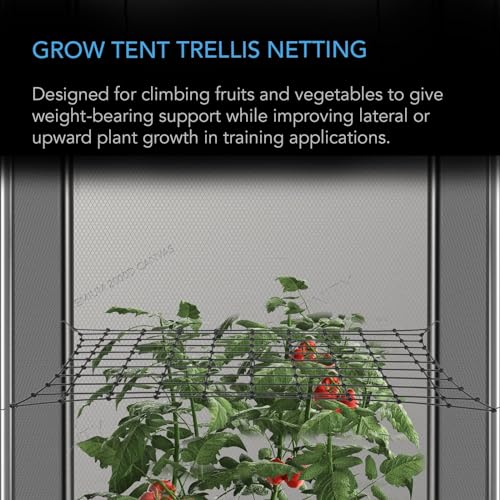
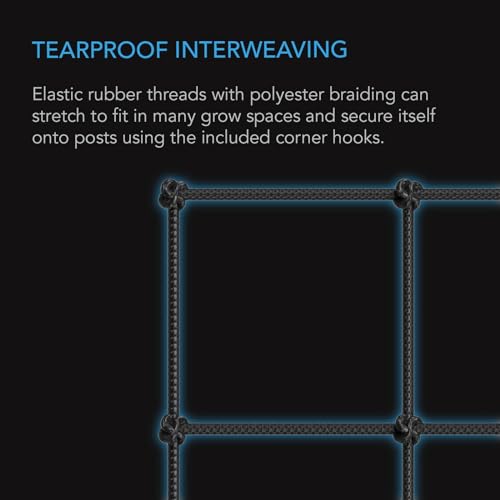
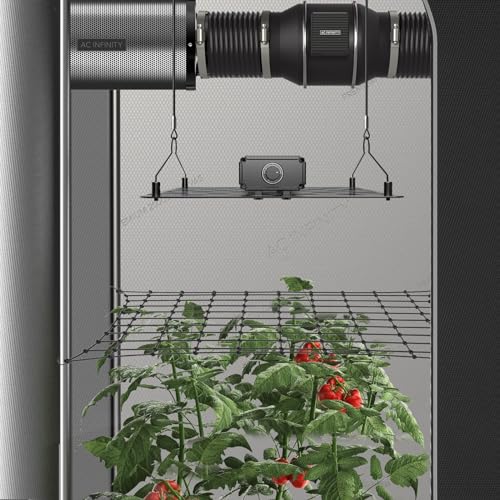
AC Infinity Elastic Trellis Netting for 2x4 Grow Tents | Heavy-Duty Elastic Plant Net with Steel Hooks, Flexible Hydroponics Support for All 24" x 48" Grow Tents

As an Amazon Associate we earn from qualifying purchases. Product prices and availability are accurate as of the date/time indicated.
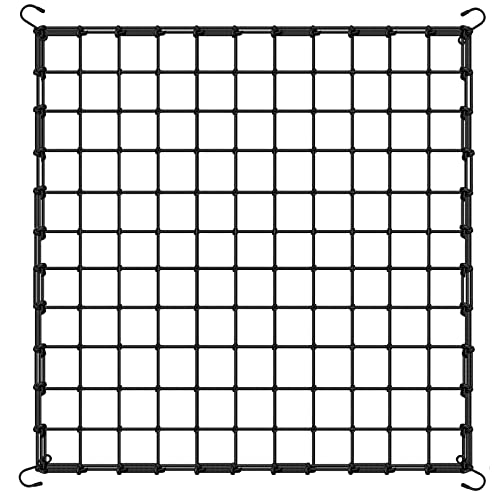
BSTPCOO 4x4 Trellis Net for Grow Tent,Heavy Duty Elastic Trellis Netting | Scrog Net with Steel Hooks for Indoor, Plant Growing Tents Garden Plant Net, Hydroponics Support for Grow Tents
As an Amazon Associate we earn from qualifying purchases. Product prices and availability are accurate as of the date/time indicated.
Prices shown are approximate and for reference only. Prices change often, so please check the current price on Amazon before you buy.
Sizes, mesh, and hook designs summarize manufacturers’ published information for current versions; measure your tent’s interior and pole diameter before purchase. Ratings are editorial, weighing tension and hook security, mesh usefulness, material durability, sizing honesty, and value.
The Six Trellis Nets Reviewed
1. AC Infinity Trellis Netting: Best Overall
AC Infinity’s net leads on the interface this guide grades hardest: hooks and elasticity engineered for the tent poles the same house sells, a mesh in the versatile middle class that conducts a SCROG and supports a stand with equal credibility, and sizing that matches the stated tent footprints with the honesty its ecosystem is known for. Its elastic holds its tension across a crop and, cleaned, across crops, and its price sits in the fair band for the quality tier. For the grower buying the first net or standardizing a room, it is the recommendation this guide defends, the net whose installation feels like a system rather than like a craft project, which at canopy scale is the difference between a technique adopted and a technique abandoned by the second crop.
2. Vivosun Elastic Trellis: Best Value
Vivosun’s nets cover the size range at prices that make the two-layer system and the annual replacement both painless decisions, with hooks and elasticity in the working class and availability everywhere the hobby shops. Their elastic fatigue across seasons is the value class’s known rhythm, answered by the price’s permission to retire and replace, and their mesh runs to the broader, support-friendly class in several sizes, which the many-plant tent will prefer and the single-plant SCROG artist should note. For the grower whose trellis budget is measured in tens, it is the rational fleet purchase, and its rating reflects a net that does the job at a price that forgives its shorter prime.
3. Spider Farmer Trellis Net: Best for Its Tents
Spider Farmer’s net is sized and hooked for its own tents with the ecosystem logic its owners expect: order the net by the tent’s name, clip it to the poles it was drawn for, and spend the saved hour on the canopy. Its mesh and elasticity sit in the versatile class, its pricing is the fair middle, and outside its own tents it remains a perfectly serviceable elastic net whose dimensions should be measured rather than assumed. It earns its row as the path of least resistance for the large installed base wearing its badge, a constituency for whom fit certainty is worth more than the last increment of any other virtue.
4. iPower Non-Elastic Netting: Best Rigid Screen
The string and mesh class, iPower’s rolls and cut sizes being the reference, serves the conductor’s role with an authority elastic cannot imitate: tied or framed at the corners, it does not yield to the stretch, and the plant is spread exactly as wide as the grower’s plan and no wider. Its costs are the philosophy’s own, installation measured in knots and patience, a harvest that cuts the screen away square by square, and a material cheap enough that the cutting is budgeted rather than mourned. For the dedicated SCROG artist with one plant and high intentions, it remains the master’s tool, and its presence in the table is this guide’s respect for the older discipline, graded on the understanding that its buyer has chosen its terms with open eyes.
5. Mars Hydro Trellis Net: Best Ecosystem Alternative
Mars Hydro’s net mirrors its lights’ philosophy, the essential specification at an aggressive price, sized for its tents and serviceable in others, with hooks and elastic in the honest working class. It concedes the leader’s fit-and-finish refinements and keeps everything the canopy will actually grade: tension that holds a crop, mesh that conducts and supports, and a price that leaves the budget for the second layer. For the Mars Hydro tent owner and the value shopper alike, it is a sound row, and its rating’s small distance from the value champion reflects a crowded class where the differences live in seasons two and three rather than in the first crop’s canopy.
6. Heavy Elastic Class for Large Tents: Best for Big Footprints
The large tents, the four-by-eights and beyond, expose the standard net’s limits, a span that sags at its center and hooks loaded past their manners, and the heavy elastic class answers with stouter cord, more hooks along the edges, and sizing drawn for the big footprints. Gorilla’s offerings and the better generics share this row, graded on the same interface rules at a harder scale. The big-tent grower should also consider running two standard nets side by side, each tensioned to its own poles, a field solution often superior to one heroic span. For the room-scale tent, this class, or that pairing, is the closing recommendation, since a trellis that sags in the middle conducts the canopy into a valley, the precise opposite of the flat map the whole technique exists to draw.
Buying Guide: How to Choose and Install the Best Trellis Nets for Grow Tents
Step One: Size to the Interior, Match the Mesh to the Method
Measure the tent’s interior footprint and its pole diameter with a tape rather than trusting the model’s name, since interiors vary by maker and the net’s hooks are sized to poles, then choose the net by the tent it must tension across, elastic nets bought to the footprint they are drawn for, string nets bought with a margin to tie. Match the mesh to the method by the guide’s rule: the fine class for the conducted SCROG of few plants, the broad class for the support ceiling over many, and the versatile middle where the tent does both across its seasons. Count the layers in the same purchase, two nets for the full system, with the second bought now rather than in week five of flower when the canopy forbids its easy installation, and add the small kit the installation consumes, spare hooks, zip ties for the string class’s corners, and the plant ties that fine-tune what the grid cannot. And the standing rule of this site, stated once for every grow room article: confirm that your indoor garden complies with your local law before it is planted or netted, and keep its electrical and environmental systems as lawful as its canopy is flat.
Step Two: Install Low, Tuck Through the Stretch, Add the Second Layer
Hang the lower net as the plants grow toward it, commonly in late vegetative growth, at the height where the coming stretch can be conducted, and begin the tucking discipline that is the SCROG’s whole craft: as each branch grows through a square, gently bend and weave it back under the net into the next square outward, spreading the tops across the grid, working the canopy every few days through the stretch’s first weeks until the map is set and the screen is full. Handle the branches like the living structures they are, bending at their pliable hours and never forcing a woody stem to a square it refuses, since a snapped top is a lesson the plant pays for. Add the upper net as the flower’s weight declares itself, a foot or more above the lower, its job purely support, the tops guided through its squares without the conductor’s agenda. Keep both nets clear of the light’s hanging zone and the fans’ sweep, and photograph the canopy weekly from the same angle, because the flat map is easier to keep than to remember, and the photograph is the honest record of whether the technique is working.
Step Three: Harvest Around the Net, Clean It, and Judge Its Retirement
Harvest with the net as a planned obstacle rather than a surprise: cut the plant’s branches free in sections, working from the top down, snipping stems below the net and lifting the tops out of their squares, with the elastic net unhooked corner by corner as its quadrants empty, and the string net cut away with the plant as its philosophy intends. Resist the pull, since a branch dragged through a grid sheds exactly the trichomes the whole crop was grown for. Afterward, clean a reusable elastic net like the equipment it is, shaken out, washed gently, disinfected by the grow room’s usual standard, and dried fully before storage, because a net stored with the last crop’s debris is a welcome mat for the next crop’s problems, pests and spores included. Judge its retirement by its tension, stretched beside its memory of itself, hooks inspected for cracks, and retire it to the support layer or to the bin when its spring is spent, promoting and replacing by the rotation the guide describes. Kept so, the trellis, the cheapest consequential object in the tent, will conduct crop after crop into the same flat, lit, supported map, which is the entire ambition of the technique and a fair return on a twenty-dollar grid.
Frequently Asked Questions About Trellis Nets for Grow Tents
What size mesh is best for a SCROG net?
For the classic conducted SCROG, one or two plants spread across the whole tent, the finer class, roughly three-to-four-inch squares, gives the grower the resolution the technique is famous for, a square for every top and the canopy built branch by branch into the light’s footprint. For many-plant tents and for the upper support layer in any tent, the broader class, five to six inches, is the better tool, asking minutes instead of evenings and holding the stand without imprisoning it. The middle class serves the mixed tent and the beginner whose method is still forming, and it is this guide’s default recommendation where the grower is unsure, since its compromises are survivable in both directions. What matters more than the last inch of mesh is the match between the grid and the grower’s actual patience, honestly assessed, because the finest net in this table, tucked twice and abandoned, conducts less canopy than a broad net worked faithfully every few days through the stretch, and the plant grades the collaboration rather than the catalog.
When should I install the trellis net in my grow tent?
The lower, conducting net goes in as the plants approach it in late vegetative growth, before the flowering stretch begins, so the first upward surge meets the grid and can be tucked from its first days; a net installed after the stretch has run is a support at best and a wrestling match at worst, its conducting moment already spent. The upper, support net follows the flower’s own announcement, commonly several weeks into flower as the tops gain the weight that leans them, placed a foot or more above the lower net and before the leaning becomes falling, since a top that has gone over is straightened at a cost in stress and sometimes in stems. Growers running a single support layer over many plants install on the support schedule alone. In all cases the net’s hooks and tension are set while the canopy still permits hands and elbows inside the tent, a practical deadline that arrives earlier than new growers expect, which is why this guide’s steps put the purchase and the plan in the vegetative weeks, when the tent is still a garden that can be rearranged rather than a thicket that can only be negotiated with.
Can I reuse a trellis net for the next crop?
An elastic net, yes, across several crops, provided it is cleaned and disinfected after harvest, dried fully, stored out of the light, and inspected for the elastic fatigue that is its lifespan’s clock, hooks sound, tension still springing back when stretched and released; a net that stays where it is pulled has become a string net with delusions and should be retired or demoted. A string or mesh net is reusable in principle and single-crop in common practice, since the harvest usually cuts it apart and its price blesses the habit, though the tidy grower who extracts it whole may wash and rerun it with this guide’s blessing. The hygiene point outranks the economics in both cases: a net is a scaffold that touched every plant in the crop, and it carries the crop’s pests and pathogens in its fibers if it carries anything, so the cleaning is not optional garnish on the reuse but its entire justification, and the grower who will not wash a net should buy the cheap class and retire it without a pang, which is a legitimate system and better than a dirty heirloom.
Do I need a trellis net if I already stake or tie my plants?
Stakes and ties solve the support half of the trellis’s work admirably and the conducting half not at all, and the honest answer divides by which half your tent needs. If your plants stand upright to harvest under stakes and yo-yos, and your canopy’s unevenness costs you little because your light’s footprint and your plants’ heights happen to agree, the net is an optional refinement and your current system has earned its incumbency. If, however, the tent’s corners grow tall while its center lags, if tops lean and shade each other by mid-flower, if the light is raised for the tallest plant while the rest recede from it, the net’s conducting is the missing discipline, and no quantity of individual ties spreads a canopy into a single plane the way a grid does, because the grid is a plan made physical, every square an instruction. Many growers run both, the net for the map and a few ties for the individuals that argue, and that hybrid, like the net itself, is cheap, reversible, and judged by the only court with jurisdiction, the harvest’s weight and evenness, crop over crop.
Related guides
- Best Rooftop Tent for Two People in 2026: Best Rooftop Tent for Two People
- Best Tent Gift for Teens in 2026: Best Tent Gift for Teens for First Campouts, Good Fun, and Simple Tent Use
- Best Tent for Beach Camping Sand Wind: 6 Best Tent for Beach Camping Sand Wind Picks in 2026
- Best Tent for Beginners Truck Camping in 2026: How to Pick a Tent for Beginners Truck Camping That Is Easy to Set Up, Fits Your Truck Bed, and Keeps You Dry
More from Amazon
Programs that pair well with the guide above. Offers and eligibility are set by Amazon and may change.
Free shipping on eligible items, Prime Video and more. Eligible new members can start with a free trial.
Start a Prime free trialAudiobooks and podcasts to listen to on the go. Eligible new members can start with a free trial.
Try Audible freeAd-free music streaming. Eligible new subscribers can start with a free trial.
Try Music Unlimited freeA free business account with business pricing and bulk-buying tools for work, shop or home office.
Create a business accountAs an Amazon Associate we earn from qualifying purchases.

Write Your Review
No reviews yet. Be the first to share your experience!