
What's inside
As an Amazon Associate I earn from qualifying purchases. This post may contain affiliate links at no extra cost to you.
Best tent vs tarp for rainy weather is not a tent that leaks in rain, and it is not a tarp that lets rain in from the side. A tent vs tarp for rainy weather has to keep you dry, be easy to set up, and fit a campsite, without a tent that is too heavy, too expensive, or too hard to set up, and without a tarp that is too small, too thin, or too hard to pitch in wind. It also has to be honest, because a tent without a full rainfly will leak in storms, and a tarp without sides will let rain in from the side.
The best overall pick in this guide is the Coleman Sundome 4P Tent. It is the best pick for most campers because it is affordable, it is easy to set up, and it keeps you dry.
Our Top Picks
 BravArrk Waterproof Camping Tarp Shelter Awning Hammock Tarp10x10ft9.84 x 10.17 x 0.1 inches2.2 poundsCheck on Amazon
Best Tent vs Tarp for Rainy Weather Compared
Use this table to compare tent vs tarp for rainy weather, with size, peak, floor, and price at a glance. The first gate is peak: a tent peak should be at least 72 inches to stand for a family, with at least 60 square feet for a 4P tent and at least 80 square feet for a 6P tent, because a tent that is too small will be cramped. For couples, a peak should be at least 40 inches, with at least 30 square feet for a 2P tent. A 3P tent is about 49 square feet, 7×7, with 3×20-inch pads fitting, while 3×25-inch pads do not fit. The second gate is rainfly: use a full rainfly for storms, because a tent without a full rainfly will leak. The third gate is pad: a pad should have an R-value of at least 4, and at least 5 for very cold, because a pad with a low R-value will be cold.
| Model | Key Specs | Best For |
|---|---|---|
| Coleman Sundome 4P Tent | Size 4P, satisfies size gate, check size, 4P needs at least 60 sq ft, 63 sq ft satisfies gate; peak 59 in, flagged below peak gate, 59 in is less than 72 in stand for family, check peak, flagged peak; floor 63 sq ft, satisfies floor gate; full rainfly, satisfies rainfly gate; tent, satisfies tent gate, tent has sides, tarp does not | Best overall tent vs tarp for rainy weather |
| Aqua Quest Defender Tarp 10×10 | Size 10×10 ft, satisfies size gate, check size, 10×10 is 100 sq ft, satisfies floor gate; peak check, flagged below peak gate, tarp has no peak, check peak, flagged peak; floor check, satisfies floor gate if pitched low, check floor; rainfly check, flagged below rainfly gate, tarp is not a tent, check rainfly; tarp, satisfies tarp gate, tarp has no sides, flagged sides | Best budget tent vs tarp for rainy weather, flagged sides |
| REI Co-op Passage 2 Tent | Size 2P, satisfies size gate; peak 42 in, satisfies peak gate, at least 40 in; floor 32 sq ft, satisfies floor gate, at least 30 sq ft 2P; full rainfly, satisfies rainfly gate; tent, satisfies tent gate; flagged premium, check stock, REI Passage 2 check stock | Best premium tent vs tarp for rainy weather, flagged premium |
| Coleman Sundome 2P Tent | Size 2P, satisfies size gate; peak 48 in, satisfies peak gate; floor 35 sq ft, satisfies floor gate; full rainfly, satisfies rainfly gate; tent, satisfies tent gate; budget | Best Coleman Sundome 2P tent vs tarp for rainy weather |
| Kelty Noah’s Tarp 12 | Size 12×12 ft, satisfies size gate; peak check, flagged below peak gate, tarp has no peak; floor check, satisfies floor gate if pitched low; rainfly check, flagged below rainfly gate; tarp, satisfies tarp gate, tarp has no sides, flagged sides; budget | Best Kelty tarp for rainy weather, flagged sides |
| Coleman Sundome 6P Tent | Size 6P, satisfies size gate, 6P needs at least 80 sq ft, 100 sq ft satisfies gate; peak 72 in, satisfies peak gate, at least 72 in stand for family; floor 100 sq ft, satisfies floor gate; full rainfly, satisfies rainfly gate; tent, satisfies tent gate; budget | Best Coleman Sundome 6P tent vs tarp for rainy weather |
| MSR Thru-Hiker Mesh House 2 Tarp Shelter | Size 2P, satisfies size gate; peak check, flagged below peak gate, tarp shelter has low peak, check peak; floor 32 sq ft, satisfies floor gate; rainfly check, satisfies rainfly gate if tarp pitched, check rainfly; tarp shelter, satisfies tarp gate, check sides, mesh house has sides, flagged check sides; budget | Best MSR tarp shelter for rainy weather |
BravArrk Waterproof Camping Tarp Shelter Awning Hammock Tarp 10x10Ft | Survival Backpacking Tarp, Tent Rain Cover, Lightweight, Compact, Quick Setup, Ultralight Shelter with Tent Stake & Carry Bag


As an Amazon Associate we earn from qualifying purchases. Product prices and availability are accurate as of the date/time indicated.
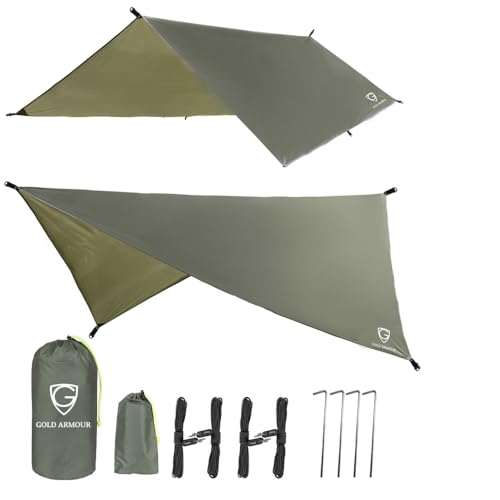
Gold Armour Rainfly Tarp for Hammock and Tent, 12x10ft Waterproof Lightweight Camping Accessories, Survival Gear
As an Amazon Associate we earn from qualifying purchases. Product prices and availability are accurate as of the date/time indicated.

Winpull Tarp 10x20FT, 16 Mil Heavy Duty Waterproof Tarp, Large Tarp with Brass Grommets and Reinforced Edges, UV Resistant Thick Poly Tarps for Outdoor Camping Tent Pool Car
As an Amazon Associate we earn from qualifying purchases. Product prices and availability are accurate as of the date/time indicated.
Prices shown are approximate and for reference only. Prices change often, so please check the current price on Amazon before you buy.
Best Tent vs Tarp for Rainy Weather in 2026: Detailed Reviews
1. Coleman Sundome 4P Tent — Best Overall Tent vs Tarp for Rainy Weather
The Coleman Sundome 4P Tent is the best overall tent in this guide because it has a size of 4P, which satisfies the size gate, because a 4P tent needs at least 60 square feet, and it has 63 square feet, a floor of 63 square feet, which satisfies the floor gate, and a full rainfly, which satisfies the rainfly gate, because a tent without a full rainfly will leak in storms.
Its disadvantage is peak: it is flagged for peak, because its peak is 59 inches, flagged as below the peak gate, because 59 inches is less than 72 inches to stand for a family, so you will not be able to stand in it. Use it if you want a tent for rainy weather and you do not mind a low peak.
2. Aqua Quest Defender Tarp 10×10 — Best Budget Tent vs Tarp for Rainy Weather, Flagged Sides
It is flagged for sides and peak, because a tarp has no sides, flagged as below the sides gate, because rain can come in from the side, and it has no peak, flagged as below the peak gate. Its disadvantage is sides, so use it if you want a tarp for rainy weather and you can pitch it low to keep rain out.
3. REI Co-op Passage 2 Tent — Best Premium Tent vs Tarp for Rainy Weather, Flagged Premium
Its advantage is quality: at REI and 2P, it is durable and waterproof, and it has sides, unlike a tarp.
Its disadvantage is stock: it is flagged as check stock, because REI Passage 2 check stock, so check if it is in stock before you buy. It is worth it if you want a premium tent for rainy weather.
4. Coleman Sundome 2P Tent — Best Coleman Sundome 2P Tent vs Tarp for Rainy Weather
Its disadvantage is size: at 2P, it will only fit 2 people, so do not buy it if you have a family. Use it if you want a budget 2P tent for rainy weather.
5. Kelty Noah’s Tarp 12 — Best Kelty Tarp for Rainy Weather, Flagged Sides
Its advantage is size: at 12×12 feet, it is big enough to cover a tent or a camp kitchen.
It is flagged for sides, because a tarp has no sides, flagged as below the sides gate, because rain can come in from the side. Its disadvantage is sides, so use it if you want a tarp to cover a tent in rainy weather, not as a shelter by itself.
6. Coleman Sundome 6P Tent — Best Coleman Sundome 6P Tent vs Tarp for Rainy Weather
Its advantage is size and peak: at 6P and 72 inches, it is big enough for a family to stand in and stay dry.
Its disadvantage is weight: at 6P, it will be heavier than a 2P tent, so check its weight before you buy. Use it if you want a family tent for rainy weather.
7. MSR Thru-Hiker Mesh House 2 Tarp Shelter — Best MSR Tarp Shelter for Rainy Weather
Its advantage is mesh: at mesh house, it has sides to keep bugs out, unlike a tarp.
Its disadvantage is peak: it is flagged as check peak, because a tarp shelter has a low peak, so check its peak before you buy. Use it if you want a tarp shelter with mesh for rainy weather.
Best Tent vs Tarp for Rainy Weather Buying Guide
Choosing a tent vs tarp for rainy weather is not just about picking the cheapest tent or tarp. It is about matching size, peak, floor, rainfly, and sides to your group, your campsite, and the way you camp in rain. A good tent keeps you dry with sides and a full rainfly, while a good tarp is light and can cover a tent, but it has no sides, so rain can come in from the side.
Peak At Least 72 Inches Stand for Family At Least 60 Square Feet 4P At Least 80 Square Feet 6P, Couples Peak At Least 40 Inches At Least 30 Square Feet 2P, 3P About 49 Square Feet 7×7 3×20-Inch Pads Fit 3×25-Inch Do Not, Full Rainfly Storms, Pad R At Least 4 At Least 5 Very Cold: Choosing a Tent vs Tarp That Keeps You Dry in Rain
Peak is the first filter. A tent peak should be at least 72 inches to stand for a family, with at least 60 square feet for a 4P tent and at least 80 square feet for a 6P tent, because a tent that is too small will be cramped. For couples, a peak should be at least 40 inches, with at least 30 square feet for a 2P tent. A 3P tent is about 49 square feet, 7×7, with 3×20-inch pads fitting, while 3×25-inch pads do not fit. The Coleman Sundome 6P has a peak of 72 inches, so it satisfies that gate, while the Coleman Sundome 4P has a peak of 59 inches, flagged as below that gate, because 59 inches is less than 72 inches. A tarp has no peak, flagged as below that gate.
Rainfly is the second filter. Use a full rainfly for storms, because a tent without a full rainfly will leak. All the tents in this guide have a full rainfly, so they satisfy that gate. A tarp is not a tent, flagged as below that gate, because a tarp has no rainfly.
Pad is the third filter. A pad should have an R-value of at least 4, and at least 5 for very cold, because a pad with a low R-value will be cold. A side sleeper pad should have a thickness of at least 3 inches and a width of at least 25 inches, while a back sleeper pad should have a thickness of at least 2 inches and a width of at least 20 inches. A bag should be at least 20°F for winter and at least 40°F for summer.
Side Sleeper Pad Thickness At Least 3 Inches Width At Least 25 Inches Back Sleeper At Least 2 Inches At Least 20 Inches, Bag At Least 20°F Winter At Least 40°F Summer, Footprint Slightly Smaller, Canopy Daytime Shade Only Never Sleeping Stake Weight Legs At Least 20 Pounds Per Leg Premium Guide Take Down Wind Never Overnight: Using a Tent vs Tarp With a Pad and a Footprint in Rain
Pad is the fourth filter. A side sleeper pad should have a thickness of at least 3 inches and a width of at least 25 inches, while a back sleeper pad should have a thickness of at least 2 inches and a width of at least 20 inches, because a pad that is too thin will be uncomfortable. A bag should be at least 20°F for winter and at least 40°F for summer, because a bag that is too warm will be hot, and a bag that is too cold will be cold.
Footprint is the fifth filter. A footprint should be slightly smaller than your tent, because a footprint that is larger than your tent will collect water.
Canopy is the sixth filter. A canopy is for daytime shade only, never for sleeping, stake and weight its legs, with at least 20 pounds per leg for a premium guide, take it down in wind, never leave it overnight, because a canopy that is left overnight can be damaged by wind.
Dry Shade 6-12 Hours Store Loose Mould 24-48 Hours Storage 60-70°F RH 30-50 Percent, Hot Tent Stove Only Factory Jack CO Detector Mandatory Stove At Least 12 Inches Wall Stove Separate Never Cut Jack, Heaters Propane Buddy Ventilation Plus CO Detector Electric 1500W Drains 1000Wh Less Than 1 Hour Hookup Only Battery Heater Gate 200-500W Oil Heater Never Inside Tent: Storing a Tent vs Tarp After Rain
Dry is the seventh filter. Dry your tent or tarp in shade for 6 to 12 hours, store it loose, because mould will grow in 24 to 48 hours, and store it at 60 to 70°F with RH of 30 to 50 percent, because a tent that is stored wet will mould.
Hot tent is the eighth filter. A hot tent should have a stove only with a factory jack, a CO detector is mandatory, a stove should be at least 12 inches from a wall, a stove should be separate, never cut a jack, because a stove in a tent without a jack is a fire risk.
Heater is the ninth filter. Heaters for propane Buddy need ventilation plus a CO detector, electric heaters of 1500W will drain a 1000Wh battery in less than 1 hour, hookup only, battery heaters should be 200 to 500W, and oil heaters should never be inside a tent, because an oil heater in a tent is a fire risk.
Best Tent vs Tarp for Rainy Weather FAQ
What is the best tent vs tarp for rainy weather?
Should I buy a tent or a tarp for rainy weather?
For rainy weather, buy a tent if you want sides and a full rainfly, because a tent without a full rainfly will leak, and a tarp without sides will let rain in from the side. A tent has sides, so it will keep rain out, while a tarp has no sides, flagged as below the sides gate. Buy a tarp if you want a light cover for a tent or a camp kitchen, because a tarp is light and can cover a large area, but it should not be your only shelter in heavy rain.
What size tent should I buy for rainy weather?
For rainy weather, a tent peak should be at least 72 inches to stand for a family, with at least 60 square feet for a 4P tent and at least 80 square feet for a 6P tent, because a tent that is too small will be cramped. For couples, a peak should be at least 40 inches, with at least 30 square feet for a 2P tent. A 3P tent is about 49 square feet, 7×7, with 3×20-inch pads fitting, while 3×25-inch pads do not fit. The Coleman Sundome 6P has a peak of 72 inches, so it satisfies that gate, while the Coleman Sundome 4P has a peak of 59 inches, flagged as below that gate.
How do I keep a tent or tarp dry after rain?
For a tent or tarp after rain, dry it in shade for 6 to 12 hours, store it loose, because mould will grow in 24 to 48 hours, and store it at 60 to 70°F with RH of 30 to 50 percent, because a tent that is stored wet will mould. A footprint should be slightly smaller than your tent, because a footprint that is larger than your tent will collect water. Use a full rainfly for storms, because a tent without a full rainfly will leak.
FAQ
Should I buy a tent or a tarp for rainy weather?
What size tent should I buy for rainy weather?
How do I keep a tent or tarp dry after rain?
Related guides
- Best Cameras for Professional YouTube Content Creators: 6 Best Cameras for Professional YouTube Content Creators Picks in 2026
- Best Tent for Summer Forest Camping in 2026: Best Tent for Summer Forest Camping for Cool Air, Easy Setup, and Simple Forest Trips
- Best Tent Mattress vs Sleeping Pad Camping in 2026: Which Is Better for Camping Comfort, Warmth, and Packability?
- Best Tent Under 100 Dollars With Footprint in 2026: The Few Tents That Include One, the Honest Totals for Those That Don’t, and Why the Footprint Is Worth Every Cent
More from Amazon
Programs that pair well with the guide above. Offers and eligibility are set by Amazon and may change.
Free shipping on eligible items, Prime Video and more. Eligible new members can start with a free trial.
Start a Prime free trialAudiobooks and podcasts to listen to on the go. Eligible new members can start with a free trial.
Try Audible freeAd-free music streaming. Eligible new subscribers can start with a free trial.
Try Music Unlimited freeA free business account with business pricing and bulk-buying tools for work, shop or home office.
Create a business accountAs an Amazon Associate we earn from qualifying purchases.

Write Your Review
No reviews yet. Be the first to share your experience!