
What's inside
- Best Tent Under 100 Dollars With Footprint: Included, Separate, and Improvised
- Best Tent Under 100 Dollars With Footprint: Quick Comparison
- The Six Budget Tent Systems Reviewed
- Buying Guide: How to Buy the Best Tent Under $100 With a Footprint
- Frequently Asked Questions About Budget Tents and Footprints
As an Amazon Associate I earn from qualifying purchases. This post may contain affiliate links at no extra cost to you.
The best tent under 100 dollars with footprint begins with a confession the product pages will not make: at this price, almost no tent includes a footprint. The footprint, the fitted ground cloth that sits under the tent floor, taking the abrasion, the punctures, and the mud in the floor’s place, is the first accessory the budget lines cut, because a tent’s floor can be advertised and a footprint’s absence cannot be photographed. So this guide does the buyer’s arithmetic honestly. It leads with the few budget tents whose bundles genuinely include a footprint, the Naturehike and Featherstone and Hyke & Byke class of the market, where the included mat is a headline feature. It then prices the mainstream favorites, Coleman, Kelty, ALPS, as systems, tent plus the maker’s fitted footprint bought separately, and shows which of those systems still land near a hundred dollars on their common sale prices and which honestly cost more, because a guide that pretends a $95 tent with a $45 footprint is a $95 tent with footprint is a guide that has spent your money without telling you. The footprint itself deserves its paragraph of respect before the table: a tent floor is the least replaceable part of the tent, the part that meets every stone, root, and tent stake the site provides, and the part whose failure, a leak at 2 a.m. in rain, ends trips. Forty dollars of fitted nylon that dies in the floor’s place, season by season, is the cheapest insurance in camping.
One alternative belongs in the introduction because every budget camper discovers it: the generic tarp or the cut-to-fit plastic sheet, polycryo and Tyvek being the ultralight world’s favorites, cut an inch smaller than the floor on every side so it cannot channel rain under the tent. It works, it costs almost nothing, and for the tent whose maker sells no fitted footprint it is the correct answer rather than a compromise. The fitted footprint’s advantages are fit, grommets and straps that clip to the tent’s own corners, and, in many designs, the ability to pitch the rainfly alone over the footprint as a summer shelter. Buy the fitted one where the system price allows. Cut the sheet where it does not. Camp on something sacrificial either way, because the floor you save is your own.
Our Top Picks
Best Tent Under 100 Dollars With Footprint: Included, Separate, and Improvised
What a Footprint Actually Does, and What It Does Not
A footprint protects the floor from abrasion and puncture, keeps it clean enough to pack without carrying the site home in mud, and adds a sacrificial waterproof layer between the ground’s moisture and the floor’s coating, which degrades a little with every trip’s friction. It does not make a bad floor waterproof, it does not replace site selection, the high, drained spot out of the hollow where water gathers, and it does not forgive a footprint larger than the floor, whose exposed edges become a rain-catching shelf that delivers water under the tent with a plumber’s reliability, which is why fitted footprints are sized an inch or two inside the floor’s outline and why a cut sheet must obey the same law. Pitch the footprint dull side up where the maker directs, clip or stake it at the corners the tent will occupy, and in a fast-pitch design, erect the fly over it first when the rain arrives mid-setup, a trick worth the whole accessory in one wet evening.
The Included-Footprint Makers: Where the Bundle Is Real
The direct-sold and value-engineered brands discovered that a footprint in the box is a headline a hundred-dollar tent can afford, and several now compete on it. Naturehike’s Cloud-Up and Mongar lines commonly bundle a footprint, called a mat in their listings, sized to the tent; Featherstone builds its Peridot around an included footprint as a stated feature; Hyke & Byke’s Zion bundles one as part of its complete-kit positioning. Read each listing with a lawyer’s eye, because bundles vary by market, by version, and by the seller’s configuration, and the words footprint included should appear in the listing you order from, not in a review of a different year’s model, this one included. Where the bundle is real, these tents are the answer to this article’s exact question, and their ratings below reflect the whole system’s honesty.
Reading a Budget Tent’s Other Numbers
With the footprint settled, the tent itself is judged by the budget class’s eternal triangle: weight, weather, and room, of which a hundred dollars buys two and a compromise. Fiberglass poles are the class’s usual concession, heavier and less storm-worthy than aluminum, serviceable for car camping and fair-weather weekends, and the first upgrade a growing camper’s second tent will correct. Capacity ratings are the class’s fiction, a two-person tent being a couple’s intimacy or a solo camper’s palace, and the honest shopper reads floor dimensions, length for their own height, width at the shoulders, and peak height for sitting up, rather than the person count. Rainfly coverage decides the weather story: a full-coverage fly to the ground is a three-season shelter; a partial fly, a cap over the roof, is a fair-weather tent whose mesh walls will admit a driven rain’s spray, fine for the summer festival circuit and a lie for the shoulder seasons. The table grades with those truths in hand.
Best Tent Under 100 Dollars With Footprint: Quick Comparison
| Tent Model | Key Specs and Footprint Status | Best For | Typical Price Range (Tent, Plus Footprint Where Separate) | Rating |
|---|---|---|---|---|
| Featherstone Peridot 2P | 2-person, aluminum poles in this line class, footprint included as a stated feature, full rainfly in this line class | Best tent under $100 with footprint included | $95 – $120, often under $100 on sale | 4.5 / 5 |
| Naturehike Cloud-Up 2 | 2-person, aluminum poles, footprint (mat) commonly included by bundle, lightweight for its class | Best lightweight bundle | $90 – $130 by version and bundle | 4.4 / 5 |
| Hyke & Byke Zion 2P | 2-person, aluminum poles in this line class, footprint included in this line class, full coverage fly | Best complete starter kit | $100 – $140, often near $100 on sale | 4.3 / 5 |
| Coleman Sundome 2 / 4 | 2 or 4-person, fiberglass poles, footprint sold separately by Coleman, dome design, car camping | Best mainstream car camping system | Tent $55 – $90 plus footprint $25 – $40 | 4.2 / 5 |
| Kelty Late Start 2 | 2-person, aluminum poles in this line class, footprint sold separately by Kelty, quick setup design | Best upgrade path under budget pressure | Tent $110 – $140 plus footprint $35 – $50 | 4.4 / 5 |
| ALPS Mountaineering Lynx 2 | 2-person, aluminum poles, footprint sold separately by ALPS, freestanding, strong value record | Best durable budget tent, footprint extra | Tent $110 – $150 plus footprint $30 – $45 | 4.4 / 5 |

Night Cat Pop Up Tent, 2-3 Persons Instant Camping Tents with Footprint Tarp & Rainfly, Double Layer Waterproof Automatic Quick Setup Popup Tent
As an Amazon Associate we earn from qualifying purchases. Product prices and availability are accurate as of the date/time indicated.

Clostnature 118x118in Heavy Duty Tent Footprint Floor Saver, Camping Tarp | 210T Polyester, Waterproof, Ultralight, Multifunctional Compact Ground Sheet Mat for Hiking, Backpacking, Hammock, Beach
As an Amazon Associate we earn from qualifying purchases. Product prices and availability are accurate as of the date/time indicated.
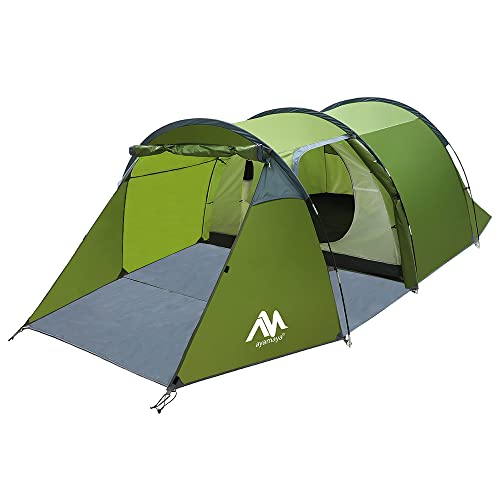
AYAMAYA 4 Person Waterproof Tunnel Tent for Camping with Vestibule Porch | 2 Divided Rooms, with Footprint & Rainfly, For Bikepacking, Motorcycle Travel, Hiking, Mountaineering
As an Amazon Associate we earn from qualifying purchases. Product prices and availability are accurate as of the date/time indicated.
Prices shown are approximate and for reference only. Prices change often, so please check the current price on Amazon before you buy.
Bundle contents vary by seller and version, especially for Naturehike and Hyke & Byke; verify footprint included in the exact listing before ordering. Prices are typical street ranges. Ratings are editorial, weighing the complete system, tent and footprint, for weather, room, poles, and value.
The Six Budget Tent Systems Reviewed
1. Featherstone Peridot 2P: Best With Footprint in the Box
The Peridot is the answer to the search as typed: a two-person tent with aluminum poles, a full rainfly, and a footprint included as a designed part of the system, clipping to the tent’s own geometry, at a street price that lives at the hundred-dollar line and visits below it on sale. Its room is an honest two-person snug, its build is the value class’s better end, and its maker’s whole positioning, complete kits for new backpackers, shows in the details the bundle brands forget. If it is in stock at its common sale price on the day you shop, the deliberation this guide offers can be short, because the Peridot is what the keyword promises and so little else at this price is.
2. Naturehike Cloud-Up 2: Best Lightweight Bundle
The Cloud-Up is the budget ultralight’s perennial recommendation: a genuinely light two-person tent with aluminum poles and, in its common bundles, the footprint mat included, at a total weight and price that embarrass tents at twice the fare. Its compromises are space and delicacy, a tapered floor that is a solo palace and a couple’s negotiation, fabrics that ask for the footprint’s protection and reward it, and listings whose exact contents must be verified with the care this guide preaches, because Naturehike’s versions and bundles are a small literature of their own. Verified and pitched on its mat, it is the most tent per dollar and per ounce in this article.
3. Hyke & Byke Zion 2P: Best Complete Starter Kit
The Zion sells the beginner a system: tent, footprint in its line’s bundles, aluminum poles, and a full-coverage fly, from a small maker whose reputation rests on campers’ forums rather than on shelf space. Its street price hovers at the line, crossing it in both directions with sales, and its value case is the same as the Peridot’s, one box, nothing forgotten, the first trip fully equipped. Against the Featherstone it trades a little polish for a little room in some versions, and the beginner choosing between them is choosing well either way, which is the happiest sentence a budget table can print.
4. Kelty Late Start 2: Best Upgrade Path
Kelty’s Late Start sits honestly above the line as a system, tent in the hundred-and-teens plus its fitted footprint, and it is included because its tent is the budget class’s better citizen, aluminum poles, a setup fast enough to justify its name, Kelty’s support behind it, and a footprint that clips in as the system intends. The buyer who can stretch the system’s total buys years here: this is the tent that survives to become the loaner, the spare, the second tent of a two-tent family. It breaks the keyword’s budget and earns its place by showing the reader exactly what the stretch buys, which is a form of honesty this guide prefers to a padded table of true hundred-dollar mediocrity.
5. ALPS Mountaineering Lynx 2: Best Durable Budget Tent
The Lynx carries the same honest surcharge as the Kelty and the same defense: a freestanding, aluminum-poled, weather-worthy tent with one of the strongest value records in the industry, whose fitted footprint, bought separately, completes a system that will outlast the bundle tents’ fabrics and the mainstream’s fiberglass alike. ALPS serves the scout troop and the summer camp, institutions that buy by the dozen and report by the decade, and the Lynx’s presence in their fleets is the review beneath this review. As a system it costs more than a hundred dollars. As a five-year cost per trip, it may be the cheapest row in the table, and the reader who plans to camp twenty nights a year should do that arithmetic before honoring the keyword’s ceiling.
6. Coleman Sundome: Best Mainstream Car Camping System
The Sundome is America’s default tent, and as a system it obeys this guide’s arithmetic with a smile: the tent is so inexpensive, in its two and four person forms, that Coleman’s own footprint, bought separately, still lands the whole near or under a hundred dollars at common prices, the only mainstream row here that can say so. Its fiberglass poles and partial-weather design confine it to car camping and fair-to-foul summer weekends, its room in the four-person is a genuine family value, and its footprint, fitted and clipped, civilizes its floor’s life completely. For the family whose camping is a campground, it remains, system and all, the rational default.
Buying Guide: How to Buy the Best Tent Under $100 With a Footprint
Step One: Price the System, Verify the Bundle
Write the system’s total for every finalist, tent, footprint if separate, and the stakes or a repair kit if the bundle omits them, and shop against that number rather than against any tent’s headline. Where a listing claims an included footprint, verify it in the listing’s own contents, in the seller’s photographs of the packed components, and in the questions other buyers have asked, because bundle contents are the most variable sentence in budget camping retail. Set your ceiling by the system, a hundred dollars strict or the honest stretch this guide’s Kelty and ALPS rows argue for, and let no configuration of a product page move it after the shopping begins.
Step Two: Fit the Tent to the Campers and the Calendar
Measure the sleepers against the floor’s length, the couple against its width, and the trip list against the fly’s coverage: full coverage and aluminum poles for any calendar that includes the shoulder seasons or real rain; the lighter bundles for summer and fair weather, owned knowingly. Weigh the packed system if a backpack will ever carry it, footprint included in the scale’s verdict, and remember that a footprint’s fast-pitch option, fly alone over the mat, can turn one of these tents into a summer shelter of half the weight, a second product hiding in the first’s stuff sack. The right tent is the one whose compromises are scheduled on days you do not camp, and only your calendar can grade that.
Step Three: Pitch It at Home, Seal It, and Care for the Floor System
Pitch the new system in the yard or the living room before the first trip: footprint down, dull side and orientation as the maker directs, tent clipped and staked over it, seams inspected and sealed where the maker leaves sealing to the owner, as several budget lines do. Confirm the footprint hides an inch inside the floor’s edge all around, with no shelf of fabric exposed to catch the rain. After every trip, pitch or drape the tent and footprint to dry completely before storage, brush the footprint’s heroic underside clean outdoors, and store the whole system loose and dry rather than compressed in its sack, because coatings die in damp compression and a budget tent’s coatings have the least life to spare. Treated so, the hundred-dollar system will give the seasons its price promises and a few it does not, which is the definition of value in this class and the note this guide is content to end its advice on.
Frequently Asked Questions About Budget Tents and Footprints
Do I really need a footprint for a cheap tent?
More than the owner of an expensive tent does, paradoxically, because a budget tent’s floor fabric and coating are its thinnest economy, and the footprint is the sacrificial layer that absorbs the abrasion those savings cannot. A footprint extends the floor’s waterproof life by seasons, keeps the tent packable without a mud ritual, protects against the puncture that ends a trip, and costs, fitted or improvised, between a few dollars of cut plastic and forty dollars of the maker’s nylon. The camper who skips it has not saved its price; they have assigned the floor its job, and the floor will retire early from it. If the budget is absolute, improvise the footprint from a tarp or sheet cut an inch inside the floor’s outline, and let the fitted version be the first upgrade the system receives.
Can I use a regular tarp as a footprint?
Yes, with two rules that decide whether it protects the tent or bathes it. The tarp must be smaller than the tent floor on every side, by an inch or two, so that no edge protrudes to catch rain and channel it underneath, which is the single commonest footprint failure in camping and the reason a too-large tarp is worse than none. And it should be as thin and light as the ground allows, a hardware-store tarp for car camping, a sheet of polycryo or Tyvek for the backpack, because a footprint’s job is abrasion, not cushioning, and bulk serves nothing. Cut it at home, fold or tape any eyelets that would sit proud, and pitch it with the same corner discipline as a fitted cloth. Improvised this way, it delivers most of the fitted footprint’s protection at a tenth of its price, surrendering only the clips and the fast-pitch trick.
What is fast-pitch, and do budget tents with footprints offer it?
Fast-pitch, also sold as a footprint-and-fly or lightweight pitch, is the ability to erect the rainfly over the footprint alone, using the poles and the footprint’s grommets or straps, leaving the tent body at home: a summer shelter, a rain canopy over a cooking area, a bug-free zone’s roof when paired with ground cover, at roughly half the full tent’s packed weight. Several systems in this table support it in their lines, the included-footprint bundles most deliberately, because the footprint was designed as the fly’s foundation rather than as an afterthought cloth. Confirm the feature in your exact model’s documentation before relying on it, practice the pitch at home, since it assembles in an unfamiliar order, and count it in the system’s value, because a tent that is also a shelter has answered two lines of the camp budget with one purchase.
How long will a tent under $100 last?
With the footprint doing its work and the care in this guide’s third step observed, a budget tent should serve a fair-weather car camper for many seasons and a backpacker for a few years of regular use, its life decided less by its price than by its drying, its storage, and the sun, which degrades every tent fabric at a rate no price class escapes. The components retire in a known order: the floor’s coating first, which the footprint postpones; the fiberglass poles’ splintering, in the lines that use them, which a pole repair sleeve in the kit answers in the field; zippers, which a season’s grit taxes and a cleaning and lubricant routine defends. Buy the system, protect the floor, dry everything, and the hundred dollars amortizes to a few dollars a night, at which point the tent has not merely lasted. It has become, by any measure the campground keeps, one of the great bargains of a camping life.
Related guides
- Best Premium Tent for Festival Camping in 2026: 7 Premium Tents That Offer Spacious Comfort, Easy Setup, and Reliable Performance for Festival Campers
- Best Family Tent With Screen Room in 2026: 6 Family Tents With a Screen Room, a Peak of at Least 72 Inches, and a Floor of at Least 80 Square Feet, for a Family, Without a Tent That Is Too Short, or Too Small, for a Family
- Best Tent for Wet Weather Camping in 2026: Full-Coverage Flys, Bathtub Floors, and Rain Ratings That Keep You Dry for Days
- Best Backpacking Tent Gift for Black Friday: 6 Best Backpacking Tent Gift for Black Friday Picks in 2026
More from Amazon
Programs that pair well with the guide above. Offers and eligibility are set by Amazon and may change.
Free shipping on eligible items, Prime Video and more. Eligible new members can start with a free trial.
Start a Prime free trialAudiobooks and podcasts to listen to on the go. Eligible new members can start with a free trial.
Try Audible freeAd-free music streaming. Eligible new subscribers can start with a free trial.
Try Music Unlimited freeA free business account with business pricing and bulk-buying tools for work, shop or home office.
Create a business accountAs an Amazon Associate we earn from qualifying purchases.

Write Your Review
No reviews yet. Be the first to share your experience!