
What's inside
As an Amazon Associate I earn from qualifying purchases. This post may contain affiliate links at no extra cost to you.
The best two room tents solve the problem that ends more family camping trips than weather ever has: everybody sleeping in one space. One room means the teenager’s midnight phone light is the toddler’s sunrise, the parents’ conversation ends when the first child sleeps, and every night-time exit is a climb over a landscape of relatives. A second room — a true divided bedroom, a screen room that converts, or a living space with its own door — restores the household’s ordinary mercies to the campsite: privacy to change, a door between bedtimes, a room for the dog, the gear, the wet coats, or the in-laws. This guide compares the real two room tents worth buying, reads their room claims as carefully as their person counts, and separates the genuine two-room designs from the single big rooms wearing a curtain and a marketing name.
That distinction is the first piece of homework, because “two room” is not a regulated term. At its best it means two sleeping spaces separated by a proper divider with its own access — ideally a door to the outside for each room, so neither room’s occupants cross the other at night. In the middle sit the divider tents: one structure, one or two doors, and a fabric wall that gives visual privacy and a psychological frontier, which for many families is honestly enough. At the category’s edge are the screen-room designs, where the second “room” is a mesh-walled porch that converts to a sleeping space in fair weather and serves as the living room in all weathers — a genuinely useful space that should be bought as a porch, not counted as a bedroom in a storm. This guide names which is which for every model, because a family that plans its sleeping around a screen room in October has been mis-sold, and it will not be by us.
Apply the standing translation to the person counts, doubled in importance here: a two room tent’s rating is its total across both rooms at sardine density, and the honest planning figure is the mattress plan per room. Lay out each room’s real tenants — the parents’ air bed in one, the children’s pads in the other — and check them against each room’s own published dimensions, not the tent’s total, because a divider in the wrong place can leave one room palatial and the other a corridor. Add the structural realities of size: these are car camping tents, with packed bundles and footprints to match, needing a pitch that fits them and a home pitch rehearsal before the first trip. Bought with those checks done, a two room tent is not a bigger tent. It is a campsite with doors that close, and families do not go back.
Our Top Picks
What Makes the Best Two Room Tents
Room Architecture: Doors, Dividers, and Who Crosses Whom
Grade a two room tent by its night-time traffic plan. The best designs give each room its own exterior door, so a parent’s dawn exit and a child’s midnight one disturb nobody. Next best is a divider with a proper zip or door panel between the rooms and one shared entrance, workable where the traffic is mostly one-way. The divider itself should run full height and full width, in fabric that gives real visual privacy, and should be removable — because the same tent must sometimes be one big room for a group of friends, a scout troop, or a rainy day’s living space. Check whether the divider’s position is fixed or adjustable, and picture your mattresses on both sides of it before anything else, because the divider’s line, not the tent’s outline, is the true floor plan of your holiday.
The Second Room’s Second Life: Living Space, Screen Room, Gear Store
In most families the second room works two jobs across a trip: bedroom by night for part of the party, and by day the tent’s living room, changing room, gear store, and rain shelter. Designs differ in how well they serve the day job. A screen room floods the space with air and view and keeps the insects out, making it the finest breakfast room in camping — and the coldest bedroom in a wind, which is the trade stated plainly. A fabric second room with windows and its own fly coverage serves all weathers as either bedroom or living space. Vestibules and awnings extend both. Choose by your climate and your party’s actual division: if the second room is a bedroom every night, buy a bedroom; if it is a bedroom only when grandparents join, buy the living space and let it flex.
Structure at Scale: Poles, Fly, and the Storm Question
Two room tents are among the largest shelters in car camping, and size is a structural commitment. Prefer aluminium or quality steel and fibreglass pole systems from makers who publish their materials, full or generous rainfly coverage over both rooms — a fly that covers only the main room leaves the second room’s occupants as the weather’s second class — and a design whose guy points you will actually use, because a big tent in a blow is a sail with your family inside it. Instant and hubbed-pole designs answer the big tent’s other cost, the hour-long pitch, and for many families the instant frame is the feature that decides the purchase; its trade is packed length and weight. Pitch any of them at home first, in full, with the divider in and the fly on: the storm pitch and the dark pitch are both rehearsed versions of that afternoon, or they are improvisations.
Quick Comparison: Best Two Room Tents Compared
| Two Room Tent Model | Best For | Key Specs |
|---|---|---|
| Wenzel Klondike 8 | Best two room tent overall | Main room plus full screen room that converts to sleeping space, two access points, published dimensions per room as listed |
| CORE 9 Person Instant Cabin | Best fast-pitch two room | Instant frame, removable room divider, tall cabin walls, multiple doors as published |
| Eureka Copper Canyon LX 8 | Best true divided bedrooms | Large cabin with room divider, near-vertical walls, standing height throughout as published |
| Coleman Hampton Cabin 9 | Best for a separate parents’ room | Cabin design with divider and hinged door, tall interior, family-focused layout as published |
| Browning Camping Big Horn 8 | Best weather-worthy two room | Two room layout with full-coverage fly emphasis, strong frame, separate room access as published |
| Ozark Trail 10 Person Cabin | Best budget two room | Cabin tent with room divider, multiple windows and doors, among the lowest prices in the class as listed |
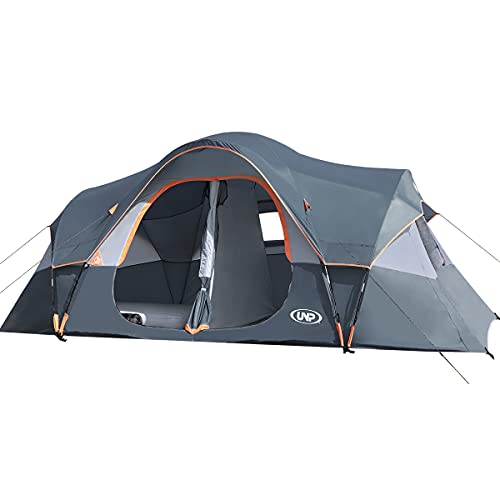
UNP 10 Person Tents for Camping Family Outdoor Camping Tent | 2 Rooms with Rainfly, Waterproof 5 Large Mesh Windows Size 18ft x 9ft x78in
As an Amazon Associate we earn from qualifying purchases. Product prices and availability are accurate as of the date/time indicated.

BravArrk Camping Tent for 6/8 Person, 1/3 Room Family Tent with Rainfly | PU3000MM Waterproof, Large Roomy Tents with Divided Curtain, Portable Outdoor Tent for Families Car Camping
As an Amazon Associate we earn from qualifying purchases. Product prices and availability are accurate as of the date/time indicated.

CAMPROS CP 8 Person Camping Tent, Room Divider, Rainfly, Weather Resistant | Family tent with 5 large mesh windows, double-layer design, and a carry bag, 14' x 9' x 72"(H)
As an Amazon Associate we earn from qualifying purchases. Product prices and availability are accurate as of the date/time indicated.
Room claims are interpreted throughout as this guide’s introduction sets out: a screen room is rated as living space that can sleep in fair weather, and a fabric divided room is rated as a bedroom, and the two are never counted as the same thing.
Best Two Room Tents: The Six Reviewed
1. Wenzel Klondike 8 – Best Overall
The Klondike is the two room idea in its most useful family form: a proper main room for sleeping, joined to a full screen room that is the campsite’s living room by day — shaded, aired, insect-free — and a fair-weather sleeping annexe by night for the older children or the guests. Its two-zone plan maps how families actually camp better than any divider alone, and its price has kept it the category’s default for years. Its boundary is the screen room’s nature, stated in this guide’s opening and honoured in this rating: plan the fabric room as the guaranteed bedroom, and let the screen room be the bonus it genuinely is.
2. CORE 9 Person Instant Cabin – Best Fast Pitch
CORE’s instant cabin answers the big tent’s setup dread: a pre-attached frame that stands the whole structure in minutes, tall walls, and a removable divider that makes the second room when the party needs it and removes it when it does not. For the family arriving on a Friday evening with tired children, that pitch time is not a convenience but the difference between camping and an ordeal with poles. Its packed length is the instant frame’s standard trade, and its weather manners are fair-weather-plus rather than expeditionary — both stated fairly against a design brief it fulfils completely.
3. Eureka Copper Canyon LX 8 – Best True Bedrooms
The Copper Canyon is the divider tent done with architectural seriousness: near-vertical walls that make both rooms’ published dimensions honestly usable, standing height from end to end, and a layout in which two genuine bedrooms — parents one end, children the other, gear and dignity between — is not a brochure claim but a floor plan. It pitches with conventional poles and takes the time that implies, and it rewards the settled, multi-night family camp more than the one-night stop. For the household whose two room requirement is a requirement, this is the guide’s recommendation.
4. Coleman Hampton Cabin 9 – Best Family Layout
The Hampton’s touches are aimed at the family’s real frictions: a hinged door that opens like a house’s rather than a zip fought in the dark, a divided interior that gives the parents’ end its own character, and the tall, windowed living quality that makes a tent a place to be in the day as well as the night. Coleman supports it with the parts and presence of the market’s largest maker. It is a fair-weather-to-moderate design in the mainstream mould, and within that brief it is one of the most liveable tents in this table.
5. Browning Camping Big Horn 8 – Best Weather-Worthy
The Big Horn serves the family whose camping does not check the forecast first: a two room layout under a fly and frame specified with weather in mind, by a maker whose tents are built for hunting camps and shoulder seasons. Its rooms are honest bedrooms in bad weather as well as good, which is the distinction this guide has pressed throughout. It costs and weighs accordingly. For the group that camps into autumn, at altitude, or on exposed ground, it is the two room tent that treats October as a month rather than a warning.
6. Ozark Trail 10 Person Cabin – Best Budget
Its materials, fly coverage, and hardware are the budget class’s, so it belongs to kind sites and kind forecasts, and its seams and zips deserve the gentle handling its price implies. Bought for the camping it suits and stored dry and carefully, it delivers the essential two room miracle — a door between the bedtimes — to families the premium class would otherwise leave in one room.
Buying Guide: How to Choose the Best Two Room Tent
Plan the Rooms by Name, Mattress, and Door
Write the sleeping plan as a floor plan: who sleeps in which room, on what mattress or pads, entering by which door, crossing whose space at night. Check that plan against each tent’s per-room dimensions and door layout, with the divider in its actual position, and reject any tent whose plan requires a mattress to fold, a sleeper to be sealed in, or a parent to cross the children’s room for the dawn exit. Then check the day plan in the same tent: where the chairs, the table, the wet coats, and the dog go when it rains at 4 p.m. A two room tent that passes both plans is your tent; the star ratings, this guide’s included, are merely the shortlist that got it to the tape measure.
Fit the Tent to the Pitch, the Car, and the Campers Pitching It
These are the largest tents most families will own, so verify three fits before purchase: the pitched footprint, fully guyed, against the pitches you actually book; the packed bundle against the car’s remaining space after the rest of the kit; and the pitch itself against the people who will perform it, in the home rehearsal this guide prescribes for every tent and insists on for these — full structure, divider, fly, and a timed strike, because striking a big tent is its own skill. Instant frames shorten the pitch and lengthen the pack; conventional poles do the reverse. Neither is a flaw. Both are the purchase, stated in dimensions.
Keep the Big Tent Like a Building
A two room tent is maintained like the small building it is: dried completely before storage — over a line, a fence, or a garage’s rafters, for as long as its size demands — stored loose and cool, its poles, stakes, and divider counted back into the bag by checklist. Inspect seams, zips, and the divider’s attachments each season, reproof and repair in spring, and keep a repair kit in the tent bag sized to the structure: pole splint, patches, seam sealer, spare stakes and guyline. Pitched on a footprint, guyed fully in wind, and never sited under dead branches, a tent of this class serves a family’s entire camping childhood — which, divided by the trips, makes even the premium models here among the cheapest holidays a family can buy.
How We Selected the Best Two Room Tents
We included only real, named, currently sold tents with genuine two-space layouts from established makers, with published per-room layouts and dimensions. Screen rooms are rated as convertible living space and fabric divided rooms as bedrooms, never conflated. Family, group, budget, fast-pitch, and weather-exposed uses were assessed separately, and structure and fly coverage were weighted alongside room count, because a second room under a failed fly is a corridor in a storm.
Frequently Asked Questions About Two Room Tents
Is a screen room the same as a second bedroom?
No, and planning as if it were is the category’s classic disappointment. A screen room is a mesh-walled living space: superb for eating, sitting, and gear in insect country, and a pleasant sleeping annexe on warm, still nights — but it offers little insulation, limited privacy, and less weather protection than a fabric room with a fly over it. Count it as a bedroom only for fair-weather overflow, and choose a tent whose fabric room sleeps the core party on its own. Bought as a living room, a screen room is one of the best spaces in camping; bought as a bedroom, it is a misunderstanding with zips.
How many people really fit in a two room tent?
Fewer than the badge, distributed by room. Work it out per room from the mattress plan: a room that takes a double air bed takes two people and their bags at a squeeze; a room with two single pads takes two children and their chaos comfortably. Most families find a tent badged for eight or nine serves five or six across two rooms in genuine comfort, with the second room’s day job preserved. The per-room dimensions in the makers’ floor plans, checked against your actual mattresses at home, give your party’s true number for any model — a more reliable figure than any capacity printed on a box.
Are two room tents hard to pitch?
They are bigger, not harder, and the difference is managed by rehearsal and design choice. Instant frames reduce the main structure to minutes at the cost of packed size; conventional pole designs take a calm twenty to forty minutes for two adults who have practised once at home. The universal rules apply with compound interest: pitch at home first, colour-code or lay out the poles before starting, stake and guy methodically, and never let the first full pitch be at a site, in weather, at dusk. Two adults who have rehearsed will find any tent in this guide unremarkable; two who have not will find all of them memorable.
Can a two room tent be used as one big room?
In most designs, yes — the dividers in the leading models are removable or openable, converting the tent between a two room family layout and a single large space for a group, a troop, or a rainy day’s communal living. Check the divider’s design on the specific model: some roll or zip away in place, others remove entirely and must be stored with the tent’s kit so they are present on the trip that needs them. That flexibility is part of what the class’s price buys, and it is worth confirming on the floor plan rather than assuming, because a fixed divider is a floor plan you cannot renegotiate.
Related guides
- Tent Poles vs Inflatable Beams Setup in 2026: Tent Poles vs Inflatable Beams Setup
- Best Tent for Kayaking in 2026: Tent for Kayaking
- Best Premium Tent for All Weather Camping: 6 Premium Tents for All Weather Camping in 2026
- Best Tent for Travelers Festival Camping Trips in 2026: Tent for Travelers Festival Camping Trips
More from Amazon
Programs that pair well with the guide above. Offers and eligibility are set by Amazon and may change.
Free shipping on eligible items, Prime Video and more. Eligible new members can start with a free trial.
Start a Prime free trialAudiobooks and podcasts to listen to on the go. Eligible new members can start with a free trial.
Try Audible freeAd-free music streaming. Eligible new subscribers can start with a free trial.
Try Music Unlimited freeA free business account with business pricing and bulk-buying tools for work, shop or home office.
Create a business accountAs an Amazon Associate we earn from qualifying purchases.

Write Your Review
No reviews yet. Be the first to share your experience!